Politicians love saying “green jobs.” It polls well. It makes for good press releases and even better election promises. But when I moved to Lake Macquarie and then Newcastle, right in the heart of Australia’s coal country, the engine room that powered Sydney for a century, I noticed something odd. Everyone was talking about the transition. Nobody was counting it.
How many green jobs are actually being advertised in the Hunter right now? What kind? Are they replacing coal jobs at the same skill level and pay grade, or are we swapping a $120k excavator operator for a $55k solar panel installer and calling it progress?
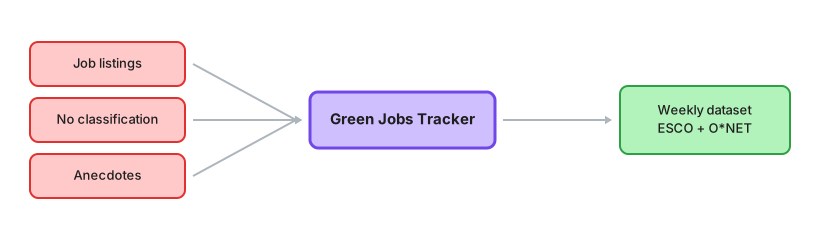
I couldn’t find the answers. Government reports are too slow and too aggregated. Job boards have no classification, no context. The media runs on anecdotes. So I built something that counts.
The Hunter Green Jobs Tracker
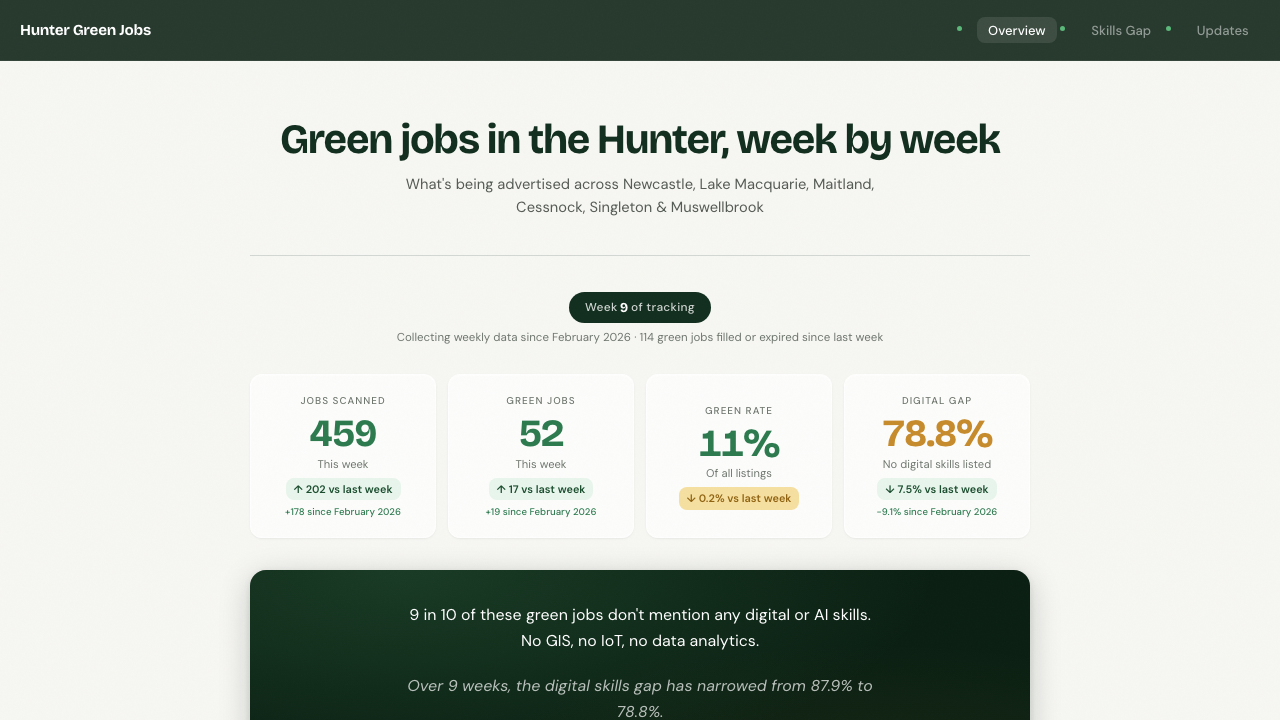
The Hunter Green Jobs Tracker monitors green job demand in the Hunter Valley region weekly. Every job listing is classified against two international taxonomies, ESCO (the European standard) and O*NET (the US standard), so the data isn’t just a count. It’s structured. Comparable. Researchable.
As far as I know, it’s the only source that measures what actually replaces coal jobs in the Hunter’s employment market. Not what politicians promise. Not what projections model. What employers are actually hiring for, right now, this week.
Why I built it
Curiosity, mostly. I live in Newcastle now. The transition isn’t abstract when you can see the power station from the highway. And I wanted to know if I could take messy, unstructured job listing data, classify it against professional taxonomies, and turn it into something a researcher or a journalist or a local council could actually cite. Not a one-off report. A living dataset that updates every week.
That’s what I keep doing. I find a question that nobody seems to be answering properly and I check whether the data exists to answer it. Usually it does. It’s just not being collected, structured, or presented in a way that makes the answer visible. It’s the same instinct behind Newy Vibes, where the question was about property, and Fish Newy, where it was about fishing conditions.
The tracker is the argument
I could write a blog post about how AI transforms data into intelligence. I could draw diagrams. List frameworks. Instead, I built a tracker that does it every week, automatically, for a question that matters to the region I live in. That’s the argument.
Everyone talks about what’s possible with AI now. Build it in a weekend. Ship it by Monday. But the more interesting question is what’s worth building. What has a reason to exist six months from now, when the novelty has worn off? What serves a need that won’t move on with the next hype cycle?
The green jobs data will still matter in five years. The energy transition isn’t going away. The Hunter will still need to know whether the promise is being kept. That’s not a technical advantage. It’s a question that keeps being worth asking.
There’s a larger story here that I’m not ready to tell yet. The data is accumulating, and it’s starting to show patterns I suspect will surprise a few people. If you work in the transition space, in regional development, or you’re trying to figure out what your workforce actually needs next year rather than what a consultant’s slide deck promises, I’d like to hear from you.