The SEO expert I worked with could read a Search Console graph the way a cardiologist reads an ECG. He’d spot the dip, trace it back three weeks, name the probable cause. Genuinely impressive. And completely useless, because by the time he finished analysing, the moment to act had passed.
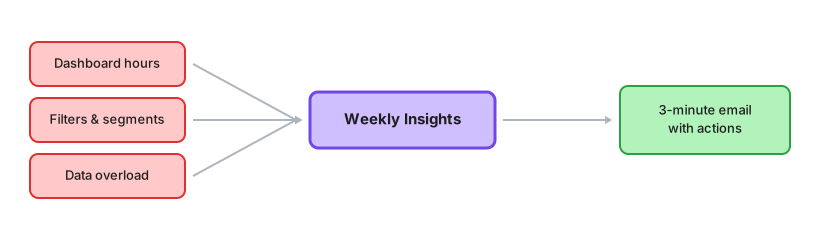
We were supposed to be optimising content together. Rewriting headlines, killing pages that cannibalised each other, pushing the things that were actually gaining traction. Instead, I’d watch him disappear into dashboards for hours. Filters applied, date ranges adjusted, segments compared. He’d surface with findings that were interesting but led nowhere. I kept thinking: mate, close the tab and do something.
I don’t blame him entirely. Dashboards are built to keep you looking. That’s how they justify their existence. But I’ve never been comfortable with that. The Germans have a useful concept: Datensparsamkeit. Data minimalism. Collect only what you need. Show only what matters. Act on what’s essential.
The tool I wished he had
I kept imagining a different version of our Monday mornings. Instead of him logging in and disappearing, what if an email had already arrived on Sunday? A short one. Here’s what changed this week. Here’s what it probably means. Here’s what to do about it.
No login. No filters. No twelve tabs. Just the bit that matters.
So I built it. Weekly Google Insights connects to your Google Search Console data and does the analysis my SEO colleague should have been doing with his eyes closed: it reads the numbers, interprets the patterns, and writes a plain-English summary with specific recommendations.
How it works
Every week, the system pulls your search performance data: clicks, impressions, positions, queries. But instead of laying it out in rows and columns for you to decipher, it runs the data through an analysis layer that understands context. It knows the difference between a seasonal dip and an actual problem. It recognises when a page is gaining momentum and suggests you double down. It flags cannibalisation before you notice the symptoms.
The output is a 3-minute read. No jargon. No charts you need a degree to interpret. Sentences like: “Your page about X dropped 12 positions this week. The likely cause is Y. Consider doing Z.”
That’s it. The signal without the noise.
Why I’m not building another dashboard
Every AI tool I see right now adds another layer. Another login, another integration, another thing to check on Tuesday morning. More data, more features, more configuration. Nobody’s life gets simpler.
My SEO colleague wasn’t lacking data. He was drowning in it. What he actually needed was something that did the analysis for him and told him where to spend his next hour.
Weekly Google Insights does that one thing. And if you need help acting on what it finds, rewriting the page that’s slipping or restructuring content that’s cannibalising itself, that’s a different conversation. But it starts with knowing where to look.
I’ve since applied the same thinking to other domains: fishing conditions in Newcastle, property intelligence, even my own trading decisions. The pattern is always the same: take the data someone is already drowning in and turn it into one clear thing to do next.