I rent a small apartment in Wickham, one of the big white buildings by the Interchange. A while back, my landlord mentioned he might be open to selling it to me. Great. But at what price?
His method: he looked up what the apartment three floors down sold for six months ago, asked ChatGPT whether prices had gone up since, and added 20%. “Do your own research,” he said.
So I did.
I wanted to know what was actually happening around the place. Not the listing photos. Not the agent’s enthusiasm. The stuff that determines whether you’ll still want to live there in two years. Is there a bar 80 metres away that trades until 3am? How many apartments are being built within 500 metres? Are there contaminated sites just down the road? How has the neighbourhood been changing, and where is it heading?
That information isn’t hidden. It’s all in government registers, public data. But it’s scattered across dozens of websites, written in bureaucratic language, and you’d need to know what to search for in the first place. The real estate agent wants to close the deal. The conveyancer checks the building: termites, defects, strata issues. Both are good at what they do. But nobody tells you about the surroundings.
What it does
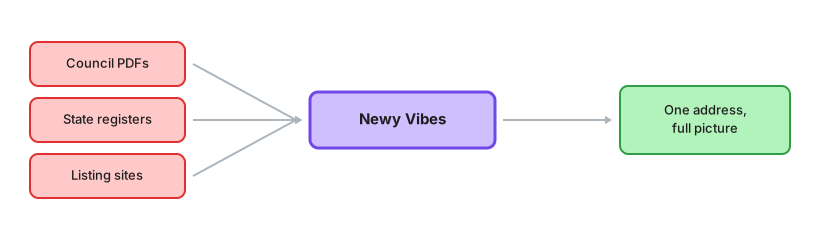
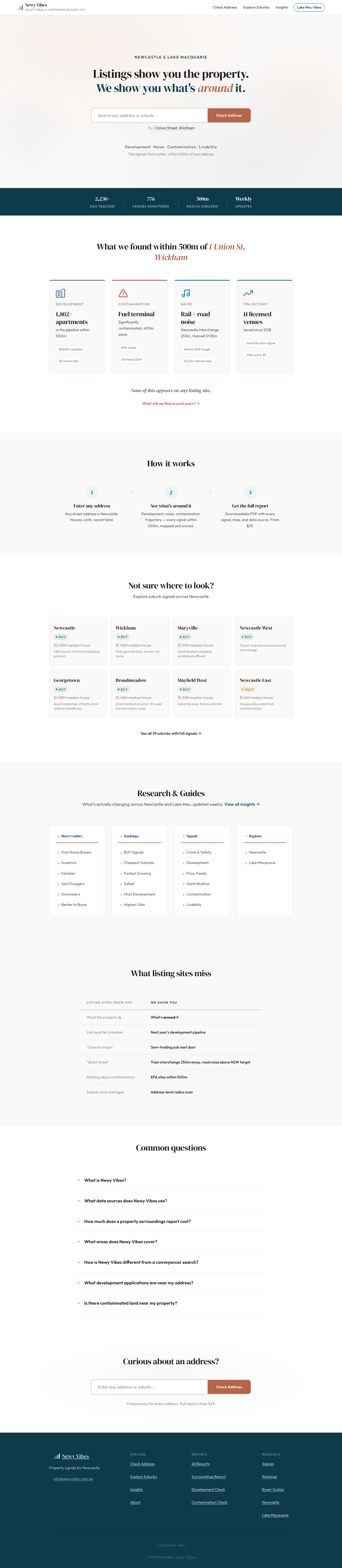
Newy Vibes pulls together what’s happening around any address in Newcastle: development applications, contamination records, venue licences, noise sources, natural hazards, how the neighbourhood is tracking. Lake Mac Vibes does the same for Lake Macquarie. The stuff that affects whether you’ll be happy living somewhere, but that you wouldn’t know to ask about.
It sits between what conveyancers search and what listing sites show. Not a replacement for either. The thing that should exist between them and, until now, didn’t.
Walking the neighbourhood
I’ve lived and worked around Wickham for a while now. I see the cranes. I hear the hammering. I watch houses get knocked down and holes appear where buildings used to be.
But I also wanted to understand something less obvious. Walk a suburb on a Saturday morning. Grab a coffee. Count the cranes. Notice what’s opening, what’s closed, who’s around. The data tells you a lot, but your feet and your eyes tell you the rest. That’s what “vibes” actually means. The feeling you get when you’re there, not just the numbers on a screen.
The public data is the foundation. Eight-plus NSW government registers and data sources, cross-referenced and updated weekly. But the suburb profiles and the signals layer on top of that come from the kind of pattern recognition you only get by being here.
Why nothing else existed
I looked. The commercial property data platforms serve developers and institutional investors, not someone trying to figure out whether the apartment they’re renting will have a six-storey building blocking the light in two years.
I wanted something that respected the question a normal person actually asks: what’s going on around this place that nobody’s telling me?
There’s quite a bit under the hood that I won’t get into here. The data pipeline, the classification logic, how often it updates and from which sources. It follows the same approach I used for Fish Newy, assembling scattered public data into something useful for one specific location. The Hunter Green Jobs Tracker does the same for employment data across the region.
If you’re curious about the architecture, or you’re wondering whether a similar intelligence layer could work for a different problem entirely, I’d enjoy that conversation.
So, did I buy the apartment? After pulling together every development application, every contamination record, every noise source around my place in Wickham — you’d think I’d know by now.
I do. But I’m not telling you. Do your own research.